


Making its entry in the books as hip-hop’s first-ever Superbowl halftime show to be solo headlined by a rapper, Compton-born wordsmith Kendrick Lamar’s LIX show is everything he promised it would be: storytelling. Fresh off winning five Grammys last week, the 22-time winner of the award had a score to settle in New Orleans, with naysayers who had bitter words aimed at him over being selected as this year’s headliner. With special guests including Oscar-winning vet Samuel L. Jackson and five-time Grammy winner SZA, the halftime show at Caesars Superdome is a tribute to Black culture and the celebration of it, as prefaced by Uncle Sam (played by Jackson), who introduces the show as the “Great American game”.
Opening his stacked eleven-song set list, the Pulitzer Prize-winning rapper sets the key of the halftime performance mood with “Bodies” while crouching atop a sable 1987 Buick GNX – a replica of the same model which serves as the face of his sixth studio album released in November. Remaining faithful to his pre-Superbowl interviews of centering his spectacle around storytelling, Lamar, performing under the lance of the spotlight with violins accompanying his brooding verse, looks like a living Le Penseur before the doors and the trunk of the GNX open and the backup dancers – arrayed in all red or all white or all blue – emerge from car and inject kinetic energy into the otherwise static square-shaped miniature stage.
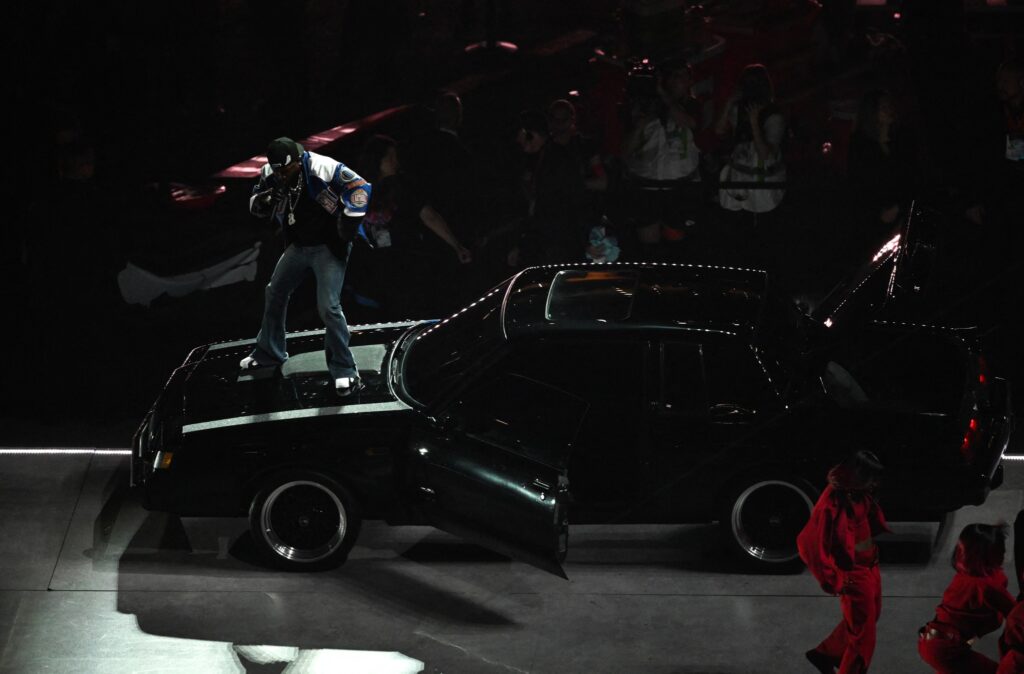
Lamar on top of a GNX | SUPPLIED
The dynamic production of the latter half of the opener phases into the next song on the list, his number-one hit “Squabble Up”, before a disgruntled Uncle Sam abruptly interjects, cautioning Lamar’s performances for being “too loud, too reckless, and too ghetto”. This portion of narration, within this 13-minute story, serves as a metonymic symbol of America, and a portrayal of the nation’s long-standing habit of policing Black culture and its artistic expressions. With the twenty-two-time Grammy winner having already established himself as rap music’s leading intelligensia and political and social commentator, the first two songs on the set list are slow-burning selections that provide two parts of Black expression: with “Bodies” representing defiant intellectualism and “Squabble Up” providing a high and proud mast for the banner of Black celebration.
Lamar’s next quartet of songs – “HUMBLE.”, “DNA.”, “Euphoria”, and “Man at the Garden” – are a musical rebuke aimed at Uncle Sam’s plea to “tighten up”, supposedly cautioning the rapper for being too Black in the curation of his culture-driven performance. Featuring two of his oldest songs, both of which date back to 2017, this section of the halftime features songs in Duckworth’s catalogue which dissect ideas of self-worth and pride in one’s heritage.
From choreography assembling the dancers into a formation which forms the Stars and Stripes to Lamar rapping a snippet of “Man at the Garden” under the prop of an on-and-off streetlight accompanied by white-clad dancers, the four songs are a crescendo in this musical drama, which culminates in Uncle Sam breaking up the performance once more. In the wake of his arrival, the dancers run in the opposite direction, signifying the way Black Americans view their country and having to run for their lives. Sam promptly breaks the Fourth Wall to tell the score keeper controlling the game to deduct “one life” from Lamar, which is a subtle nod to the plight of Black people being victimised and killed Uncle Sam for simply being Black and proud about it.
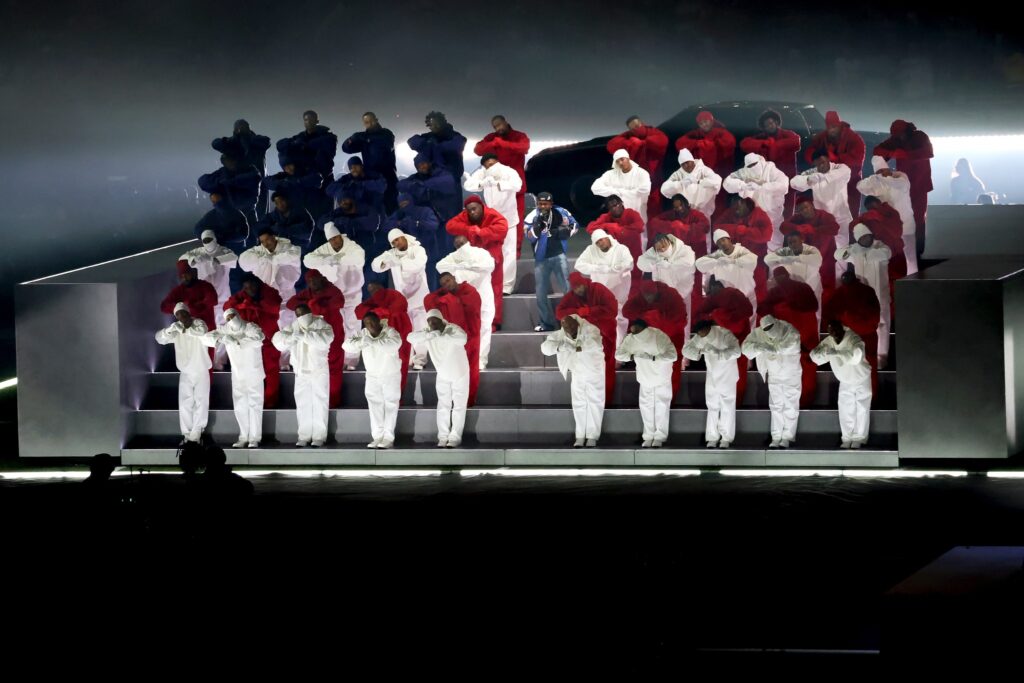
Lamar and the dancers forming the American flag | SUPPLIED
The halftime show’s third act, opening up with the party-starting “Peekaboo”, starts within the X-shaped mini platform of the field, featuring three groups of white-dressed dancers organised within each prong. This is the portion where Lamar begins to edge spectators by teasing the risque move of performing “Not Like Us” as he tries to shrug off the discouragement he might face from Uncle Sam and a veiled dig as Drake (“I wanna perform they favourite song, but you know they love to sue”).
After lightening the atmosphere with the comic relief, Kendrick Lamar brings out former TDE labelmate SZA for “Luther” and “All the Stars”. One of the most artistic strokes of thought-provoking brilliance from the choreography comes from this segment of the show, where Lamar and SZA perform on top of the O-shaped mini stage, which is orbited by red and white dancers arranged in an alternating pattern while the rest of the dancers march on the field in disciplined, military-esque steps. This particular part of the show and symbolism represents the stars being sang about while also referring to the Black bodies who once formed the flag during the show. The red dancers could very well speak of blood, a tacit allusion to the blood of the stars being spilled in America.
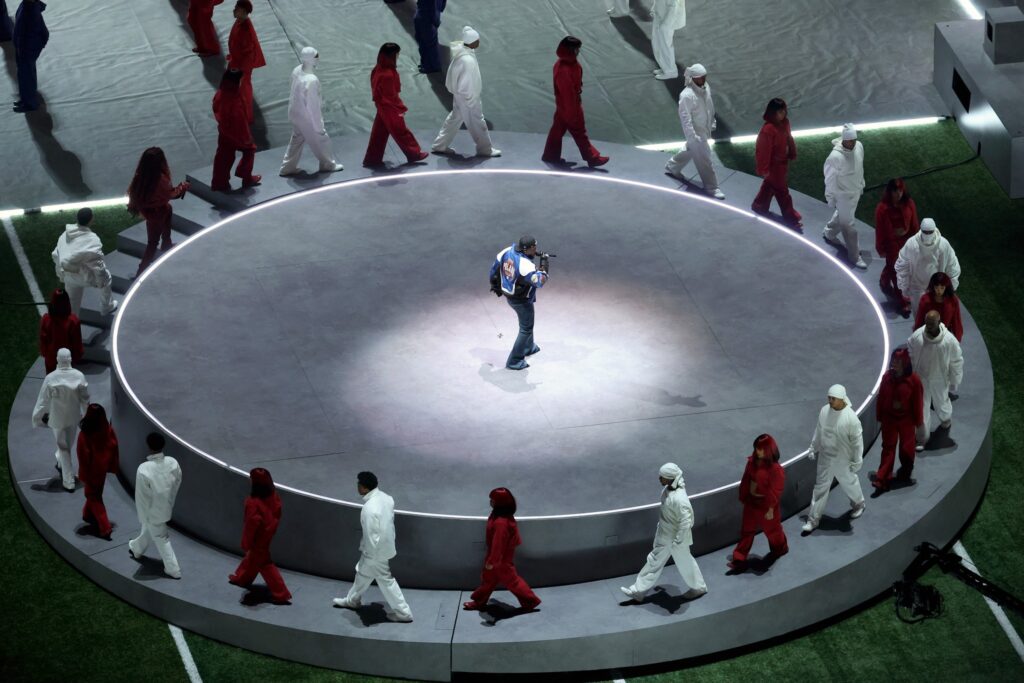
Lamar on the circular mini stage orbited by dancers | SUPPLIED
Following subtle soft-launches of “Not Like Us”, Kendrick Lamar defies Uncle Sam – who seems satisfied with his recent three-song section alongside SZA – and uses the whole stage to perform his Grammy-sweeping beef haymaker landed on Drake, with the performance featuring a cameo from American former tennis superstar Serena Williams doing the Crip walk while dressed in blue. Sporting a lowercase “A” chain as an unspoken “A-minor”, since he couldn’t say it on stage (though the crowd chorused it on his behalf), Kendrick then pulls off a memeable moment during his performance as he looks squarely at the camera with a menacing smirk as he says, “Say Drake”.
Capping his performance with the famous “MUSTAAAAAAARD!” line, Lamar brings out DJ Mustard as his final guest to perform “TV Off”, his closing song, before Lamar tells the camera to “turn his TV off”, prompting the stadium to be blanketed in all black before the words “game over” in uppercase light up on the stands.
Kendrick Lamar’s halftime show doesn’t aim to simply impress with hits but to tell the story of Black culture while also making the event a celebration. The double entendre of the dancers being clad in all blue and all red represents Lamar’s ability to unify (the Crips and the Bloods) on a regional level while also painting the bigger picture of the struggles of Black people countrywide. A game of symbolism, the LIX halftime show is not one for everyone, but for anyone who knows and those willing enough to learn to decipher the intimate intricacies that went into the multi-layered curation of the set list, storytelling, and choreography.


