


“This offering is a surrealist hymn book that sets the landscape for everyone and anyone’s spirit and unconscious world if they so choose. Coded with sounds and messaging of places of worship, new age sounds, memory, choral spaces, mantras, and healing energy. A sacral, spirited, ceremonious, whimsical, cinematic work that brings us towards our inner, godlike selves. It leans into the divine feminine energy, the matriarchal influence, the nurturing of spirit and of self. Based on real stories and perspectives about the Creator, higher self, loss, love, it is conjuring the memory we carry in us as we seek the divinity within ourselves and evidently see all around us”. – Zoë Modiga
When you consider where Zoë Modiga was born and raised, you might be under the impression that it’s like any other township, plagued by crime, violence, taverns and below-the-poverty-line social ills. However, Imbali, Pietermaritzburg, KwaZulu-Natal is considered by its people as the flower of the garden of Eden as it is the centre of the greater Edendale area in the Natal homelands and its people take their spiritual walk with the utmost care and delicacy.
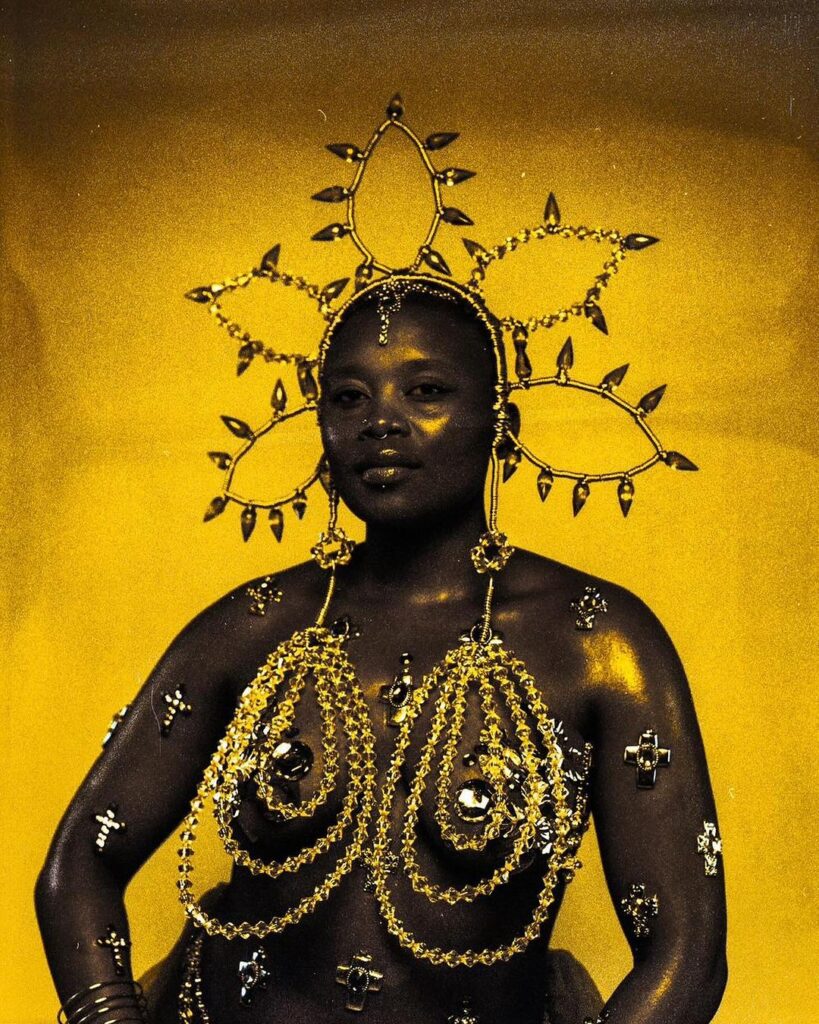
The people of Imbali, much like credited academic and non-academic philosophers, intuitively have an understanding of the intricate details of one’s upbringing that fundamentally shapes not only the bedrock of their adulthood and scope of opportunity but also what kind of character said adults have as they impact the status quo of our ever-evolving society. In the decoded Instagram snapshot for nomthandazo, Modiga reflects:
“Nomthandazo closely translates to “Mother of Prayer”. This heart works as an ode to both my darling, prayer warrior grandmothers: paternal, Mpondo and living, uMaBabalazi, uMafotini and maternal, Zulu and heaven bound – whom I was named after – uMaKhumalo, uNomthandazo. This dear name, “Nomthandazo”, was given to me by her husband, who also happens to be my first best friend, my beloved grandfather, Jacob Mosetla Modiga. Though I never met ugog’ Nomthandazo in this life, so much of her life runs through my veins. Umakhulu, on the other hand, has been home to so many lifetimes in me; in knowing her, I have met myself.”
“Our leading ladies, to some, carry a presence that is stern and unbending; to me, I see many endearing, floating images: the aroma of white porridge with milk, sugar and butter in the morning, the zephyr uttering of the Lord’s prayer, a particular image that was found in many black, South African homes of a mother and child, the sofas wooden hands coming alive from red furniture polish, the regal, stately church uniform, the loving, wrinkled hands that hold white candles, rosaries and bibles, an omnipresent, reprimanding love that need not announce itself, a needle and thread mending school uniform, waking up to the sound of a broom on a Saturday. I also catch wind of the things I don’t see, the mysteries of a full life filled with victories and lessons lived that I never bore witness to.”
Stream “uyakhazimula” Here:
With her meditative new album nomthandazo, Zoë Modiga has transcended genre while tapping into the very depths of the human spiritual condition. The multi-award-winning South African singer-songwriter and performer’s ambitious third LP is nothing short of a cinematic sacred song cycle – a majestic opus that blends jazz, Afro-pop, neo-classical, and hints of gospel into a surrealist hymnal for the modern age. On nomthandazo, Modiga explores the innermost spheres of ancestral veneration, feminist empowerment, and humankind’s eternal yearning for cosmic enlightenment. Her lush, layered textures and full-bodied vocals envelop the listener in lush, sacred tones as she invokes the divine matriarchal wisdom that flows through her bloodline.
Central to this transcendent work is Modiga’s profound exploration of the divine feminine through vivid symbolism and deep personal ancestral connections. The album artwork depicts the singer as a surreal quasi-mythical figure, portraying the “reimagined ethereal female form” that represents the powerful divine life force she taps into. Yet Modiga isn’t merely deifying an abstract feminine ideal but paying tribute to the real “matriarchs” and “prayer warrior” women like her grandmothers who have spiritually anchored her existence.
Water serves as a powerful metaphysical symbol representing the bridging of ancestral realms. Modiga associates it with maternal nurturing and the sacred feminine, feeling closest to prayer near “bodies of water.” Her fluid vocal flows convey the transition between corporeal and spiritual planes, even on heavier songs. Similarly, she embraces matrilineal names and their profound legacies as talismans, which she bears with profound self-questioning: “I wonder, will I be remembered as having lived out this weighted name and will my legacy hold like those I come from? Do I carry it well?”
By centring the sacred feminine through the intimate vessel of her ancestral matriarchs, Modiga makes their identities and life forces transcendent and palpable. She doesn’t treat them as obscured relics but as embodied portals for experiencing the infinite and eternal in the present. nomthandazo essentially serves as her spiritual conduit for channelling the immortal goddess energies carried within her very being.
Right from the heavenly harmonies of the opening hymn, “siyabonga,” Modiga initiates us into her spiritual realm – an immersive journey oscillating between ecstatic celebration and sombre self-reflection. With records like the empowering “indlela” and cosmic Afro-funk number “ntando yakho” radiate uplifting joy, while more pensive cuts like the orchestral title track and autobiographical “uyakhazimula” bore into the deepest esoteric caverns of Modiga’s consciousness with poetic musings paying homage to her roots and what shaped her impeccable character.
Most remarkable is how Modiga alchemizes her intimate familial narratives into profound allegories that resonate universally. On the centrepiece, nomthandazo, the singer pays reverent homage to the divine feminine life-givers and nurturers that have shaped our civilization. Over its climactic swells, Modiga seems to channel an eternal cosmic wail – honouring the nameless “omama bomthandazo” (prayer warrior women) who held communities together through faith and resilience over a breathtaking orchestral bedrock.
Modiga’s vocals themselves contain volumes of nuanced mysticism and raw soul. Her delivery on tracks like the wrenching “nkunz’emdaka” and celestial “amen” emotes the full depth of grief, mortality, and cathartic spiritual affirmation. Even when depicting life’s most painful quarrels on the poignant “bengemanzi,” Modiga maintains regal poise.
Stream “amen” Here:
While nomthandazo is undoubtedly a work of immense spiritual magnitude, Modiga’s achievement lies in how she grounds these ethereal concepts in visceral, physical humanity. Her evocations of the divine feminine don’t feel like mere abstractions but instead rooted in the tangible realities and sacrifices of the women who raised her. On the sublime “ngelosi,” Modiga crafts a tender lullaby to her inner child over delicate vocal layers, reassuring, “You carry good fortune; you are a gift.” It’s a gentle reminder of the nurturing maternal love that shaped her. The groove-laden “get lifted” is an empowering exaltation of the “lightworkers” and modern-day mystics walking among us as sacred guides. Yet she doesn’t deify these women as infallible goddesses but portrays their full-dimensional humanity. On the simmering “bengemanzi,” based on a Zulu proverb, “abantu abayi ngandawonye bengemanzi”, which loosely translates to “people will not always be in agreement about a particular thing.” Modiga paints a nuanced portrait of the inevitable conflicts in relationships and how “even different opinions have a meeting point.” The song’s undulating vocal harmonies embody the hard-won reconciliation after turbulence.
With nomthandazo, Zoë Modiga has crafted a holistic artistic vision that astounds and grounds the listener. Her spiritual world-building is immersive and multidimensional, lingering long after the sublime final notes of “where do people go?” Her achievement isn’t just in creating a majestic “surrealist hymnal,” but making it tangible – tapping directly into the paradoxical essence of mortal humanity and infinite divinity coexisting. nomthandazo – universe unto itself that one can infinitely experience and expand within.
Stream “nomthandazo” Here: https://orcd.co/nomthandazo


